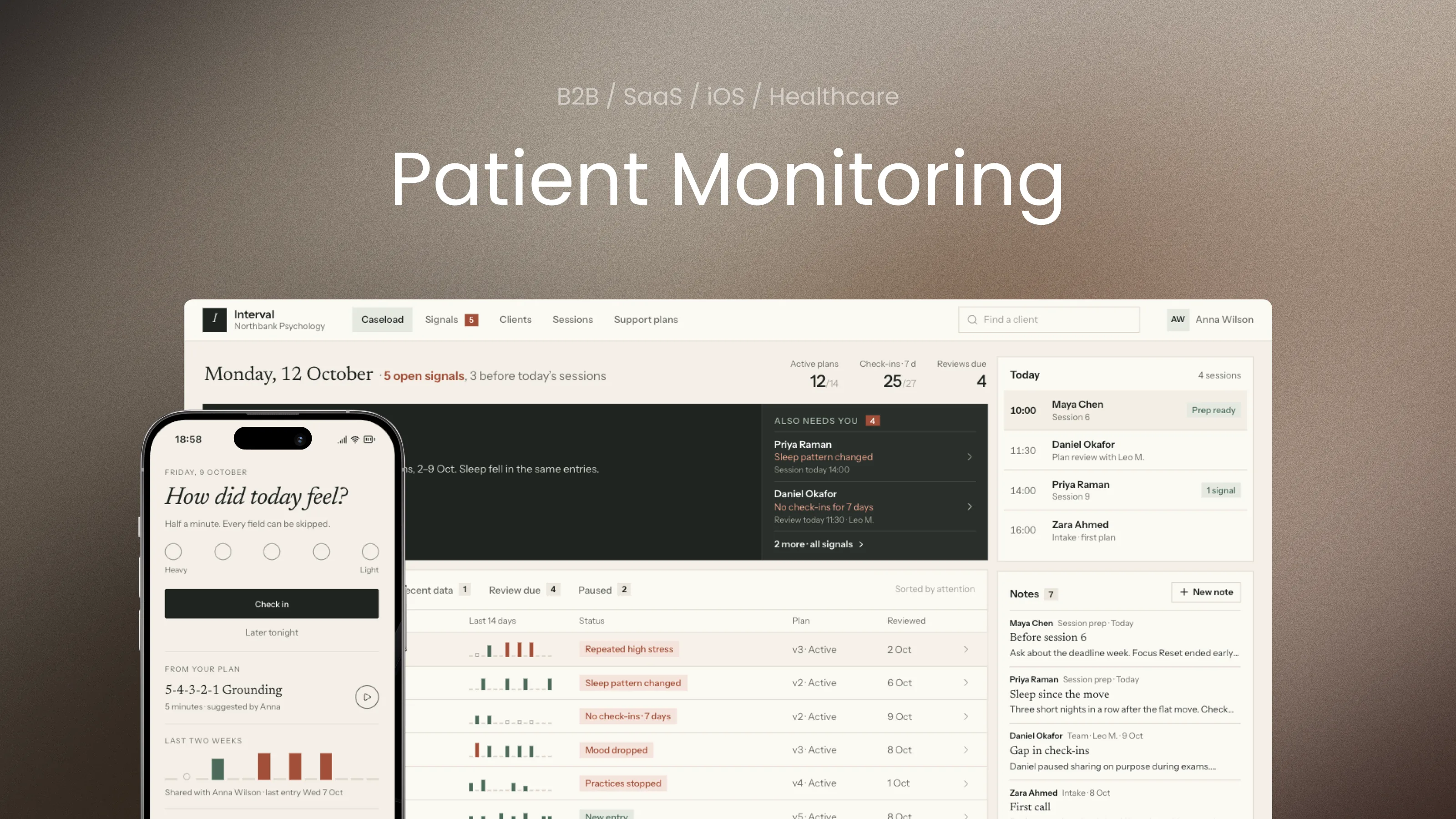
Client Monitoring & Support Plan

Between-session wellbeing monitoring and guided self-regulation

iOS + WEB
Client Monitoring & Support Plan
Role: Product DesignerPlatform: Wellbeing support · iOS application + web dashboardScope: Domain research, product architecture, UX/UI, responsible monitoring, analytics

A wellbeing product I worked on for psychological support between consultations. A client records a small amount of context about mood, stress, sleep and daily events, then can choose a recommended self-regulation practice. A psychologist sees the shared history, prepares for the conversation and adjusts an agreed support plan.

The product does not diagnose, prescribe treatment or promise an emergency response. Its role is narrower and more useful: preserve what happens between sessions, make changes visible and return that context to a thoughtful conversation.
Product direction

A digital layer between sessions

The experience follows a simple loop. The client notices and records a state, chooses an appropriate practice, reflects on the result and later discusses the context with a psychologist. The support plan changes through that shared understanding.

  1. 01

    Check in

    Record mood, stress, sleep and optional context in under a minute

  2. 02

    Notice

    See the current state without diagnosis or judgement

  3. 03

    Choose

    Pick a breathing, grounding, focus or meditation practice

  4. 04

    Reflect

    Optionally note how the state feels after the practice

  5. 05

    Discuss

    Review patterns and events together during a consultation

  6. 06

    Adjust

    Update goals, cadence and practices in the support plan

Chapter 01 · Psychologist · Web

Notice without monitoring

The psychologist moves from a broad operational view to one client’s story: first noticing who may need attention, then understanding the source data, preparing a session and agreeing on a support-plan change.

Problem
Entries arrive within seconds, but a psychologist cannot and should not watch them. Risk scores without sources create anxiety instead of preparation, and the week’s context is still lost by the time of the session.
Hypothesis
An explainable signal linked to its source entries, a review window the client also sees and a session-preparation view help the psychologist prepare without promising an immediate response.
What the domain says
Availability is not continuous monitoringNew entries can appear in seconds, but the interface must never imply that a psychologist is watching or responding at all times.
IntervalNorthbank PsychologyFind a clientMon 12 Oct09:10AWAnna WilsonPsychologist

Monday, 12 October · 3 open signals, 3 before today’s sessions

Active plans
12/14
Check-ins · 7 d
25/27
Reviews due
4
Next · session at 10:00

Maya Chen

Repeated high stress — Stress 4–5 in 3 of the last 4 check-ins, 2 – 9 Oct.

Also needs you 2

  • Priya RamanSleep pattern changedReview when preparing session · owner you
  • Daniel OkaforNo check-ins for 7 daysReview soon · owner Leo
ClientLast check-inLast 14 daysStatusPlanReviewed
MCMaya ChenSince 18 Sep3 days agoRepeated high stressNewv3Active2 Oct · session
SMSofia MarquezSince 3 AugToday, 08:41—v5Active8 Oct
PRPriya RamanSince 14 JulToday, 07:55Sleep pattern changedViewedv2Active6 Oct
DODaniel OkaforSince 21 Aug10 days agoNo check-ins for 7 daysNotedv2Active9 Oct · Leo M.
LFLucas FerreiraSince 1 Sep3 days agoSync delayed—v1Active5 Oct
JLJonas LindqvistSince 27 Jul10 days agoSharing paused—v3Active2 Oct
ANAmara NwosuSince 10 Jun4 days ago—v4Active1 Oct
TBTom BeckerSince 2 Jun10 days ago—v3Paused2 Oct
EPElena PopescuSince 5 Sep3 days ago—v2Active7 Oct
KWKenji WatanabeSince 19 Aug3 days ago—v3Active8 Oct
HWHannah WrightSince 30 Jun3 days ago—v2Active5 Oct
OBOlivia BrooksSince 12 AugYesterday, 10:30—v1Active9 Oct
NSNoah SchmidtSince 26 Aug3 days ago—v2Active6 Oct
ZAZara AhmedInvited 8 OctNo entries yet——Invited9 Oct · intake
Last 14 daysRecordedSkippedWaiting to syncPrivate
01Open Maya’s new signal
06

Caseload

Clients ordered by recent activity, upcoming review and explainable attention signals.

07

Attention signals

Reason, source data, age, owner and a neutral review state, without an emergency SLA.

08

Client overview

Timeline combining check-ins, practices, notes, signals and plan changes.

09

Session preparation

Changes since the last session, recurring context and links to original entries.

10

Support-plan editor

General goals, check-in cadence, suggested practices, sharing and version history.

Chapter 02 · Psychologist and client

Start with an agreement, not with data

Zara has had her first consultation and an invitation is waiting. Before anything is collected, the psychologist turns the intake into a light first plan, previews it as Zara will see it and sends it. Zara accepts on her phone, chooses what to share and acknowledges the plan. Only then does support become active.

Problem
Monitoring products often start collecting on day one. Clients agree to sharing they do not fully understand, and the purpose of each field stays implicit.
Hypothesis
If support starts with a short plan from the intake and the client chooses what to share, consent becomes informed and the data that follows has a reason to exist.
What the domain says
Collection needs a visible purposeA check-in earns its place only when the client understands why it is asked and the psychologist can use it in a later conversation.
IntervalNorthbank PsychologyFind a clientMon 12 Oct10:30AWAnna WilsonPsychologist

Monday, 12 October · 3 open signals, 3 before today’s sessions

Active plans
12/14
Check-ins · 7 d
25/27
Reviews due
4
Next · intake at 16:00

Zara Ahmed

No support plan yet — Invited 8 Oct. Start her first plan before the intake.

Also needs you 3

  • Maya ChenRepeated high stressReview when preparing session · owner you
  • Priya RamanSleep pattern changedReview when preparing session · owner you
ClientLast check-inLast 14 daysStatusPlanReviewed
MCMaya ChenSince 18 Sep3 days agoRepeated high stressNewv3Active2 Oct · session
SMSofia MarquezSince 3 AugToday, 08:41—v5Active8 Oct
PRPriya RamanSince 14 JulToday, 07:55Sleep pattern changedViewedv2Active6 Oct
DODaniel OkaforSince 21 Aug10 days agoNo check-ins for 7 daysNotedv2Active9 Oct · Leo M.
LFLucas FerreiraSince 1 Sep3 days agoSync delayed—v1Active5 Oct
JLJonas LindqvistSince 27 Jul10 days agoSharing paused—v3Active2 Oct
ANAmara NwosuSince 10 Jun4 days ago—v4Active1 Oct
TBTom BeckerSince 2 Jun10 days ago—v3Paused2 Oct
EPElena PopescuSince 5 Sep3 days ago—v2Active7 Oct
KWKenji WatanabeSince 19 Aug3 days ago—v3Active8 Oct
HWHannah WrightSince 30 Jun3 days ago—v2Active5 Oct
OBOlivia BrooksSince 12 AugYesterday, 10:30—v1Active9 Oct
NSNoah SchmidtSince 26 Aug3 days ago—v2Active6 Oct
ZAZara AhmedInvited 8 OctNo entries yet——Invited9 Oct · intake
Last 14 daysRecordedSkippedWaiting to syncPrivate
01Open Zara’s profile
Chapter 03 · Client · iOS

The client app supports the moment without taking it over

The mobile experience stays deliberately small. It helps the client notice a state, record only useful context, choose a suitable practice and later return to a readable personal history.

Problem
Between sessions a check-in easily turns into homework and a practice into a prescription. Pressure lowers honesty and makes people stop logging.
Hypothesis
A check-in under 45 seconds where every field can be skipped, and practices offered as options without claims of effect, will keep entries honest and regular.
What the domain says
Practices are tools, not treatmentBreathing, grounding and meditation support self-regulation. They are options, not automated prescriptions or proof of improvement.

Six core screens

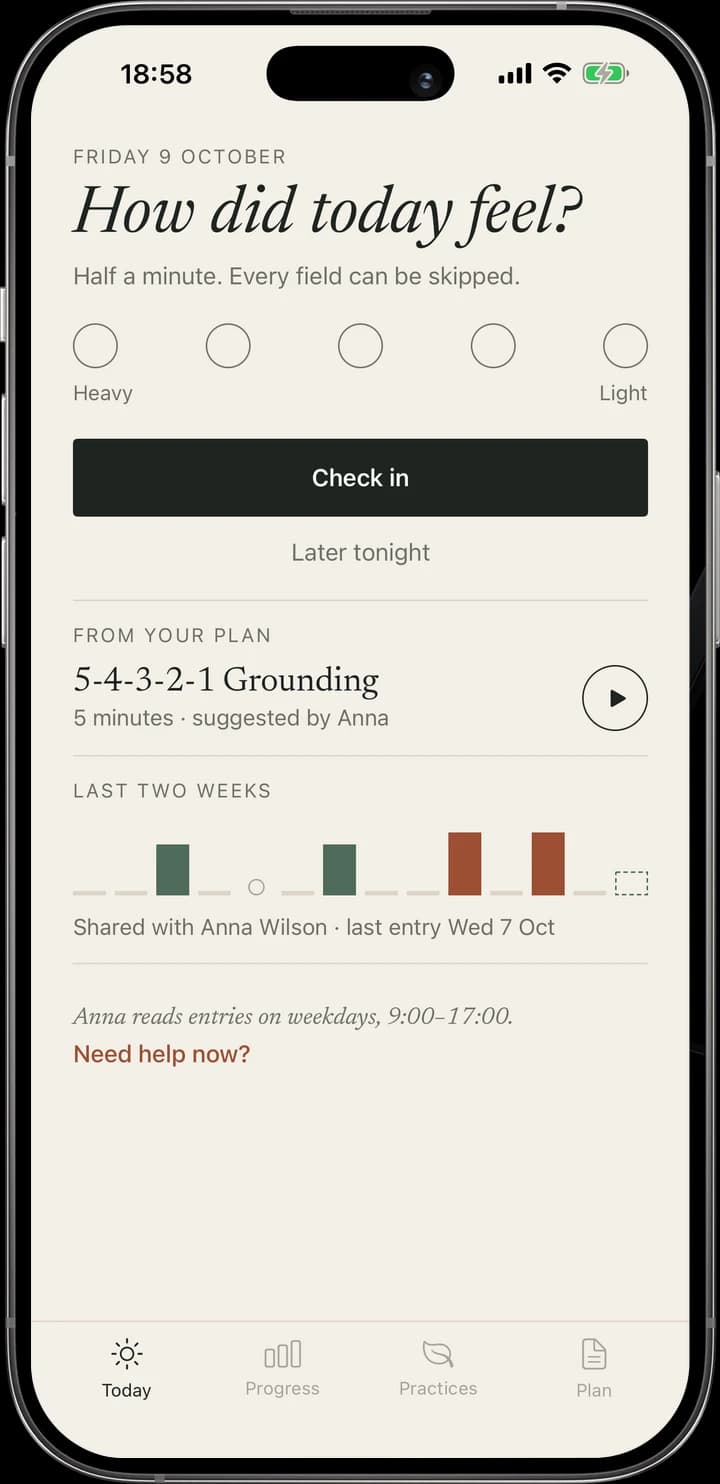
Today: The day’s one question as the headline, a practice from the plan, the last two weeks in one quiet strip and when Anna reads entries.
TodayThe day’s one question as the headline, a practice from the plan, the last two weeks in one quiet strip and when Anna reads entries.
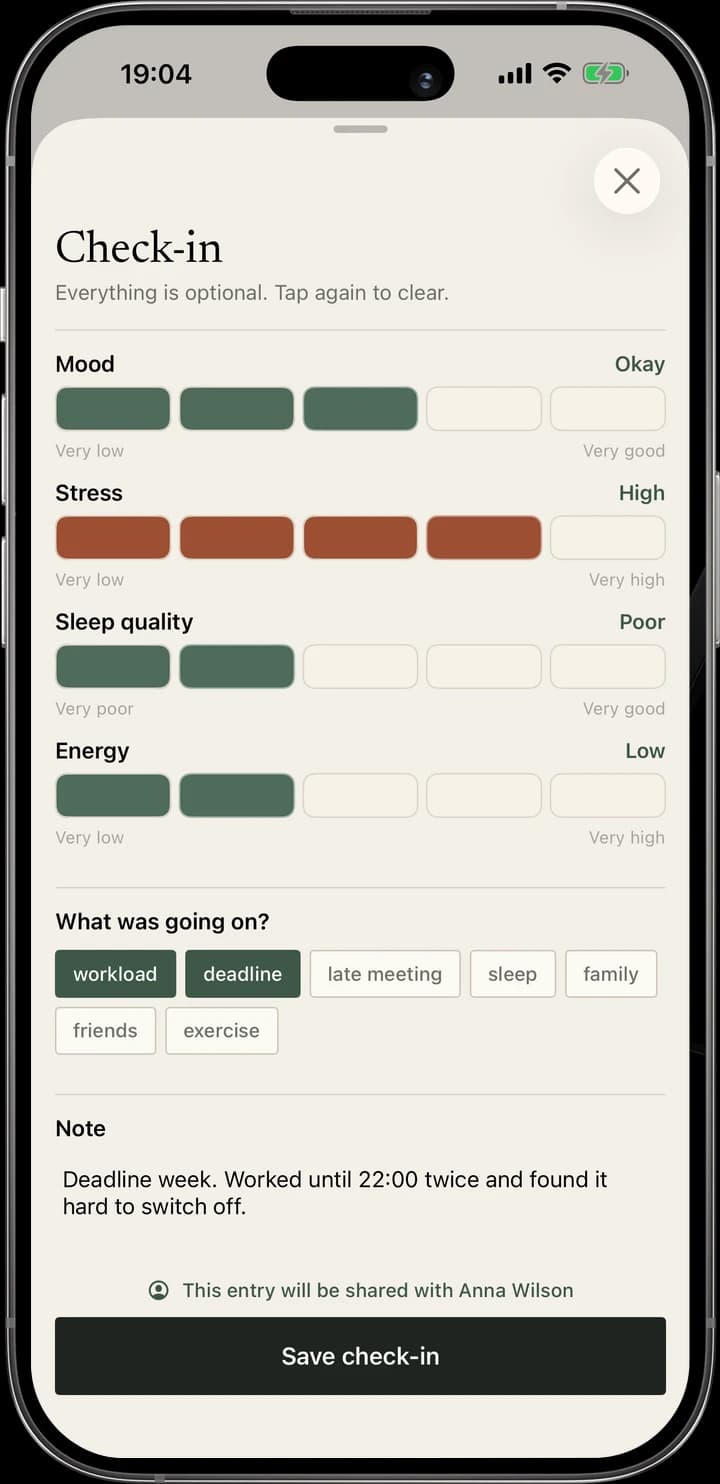
Quick check-in: Four scales with words instead of numbers, context tags and a note; the sharing scope is visible before saving.
Quick check-inFour scales with words instead of numbers, context tags and a note; the sharing scope is visible before saving.
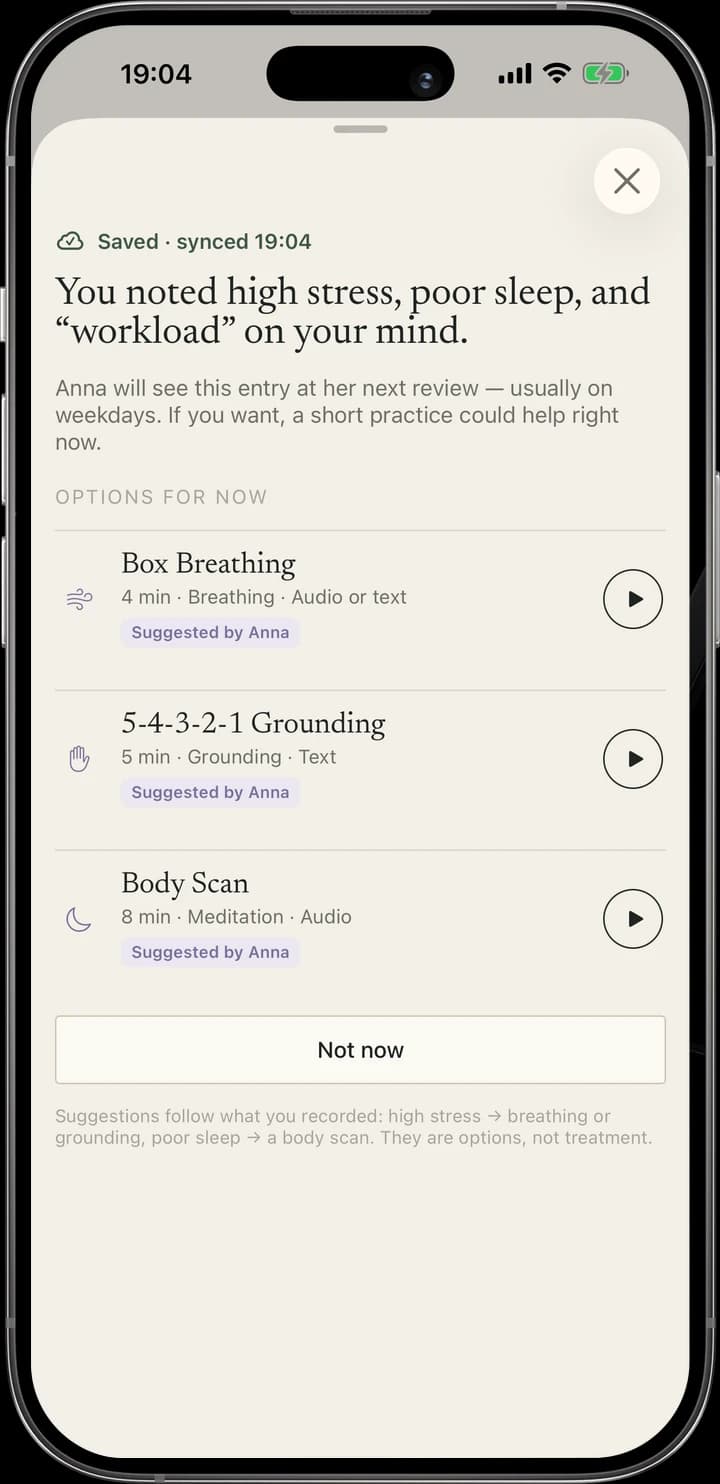
Reflection: A neutral mirror of the entry and a few practice options from a transparent mapping. It is never presented as a prescription.
ReflectionA neutral mirror of the entry and a few practice options from a transparent mapping. It is never presented as a prescription.
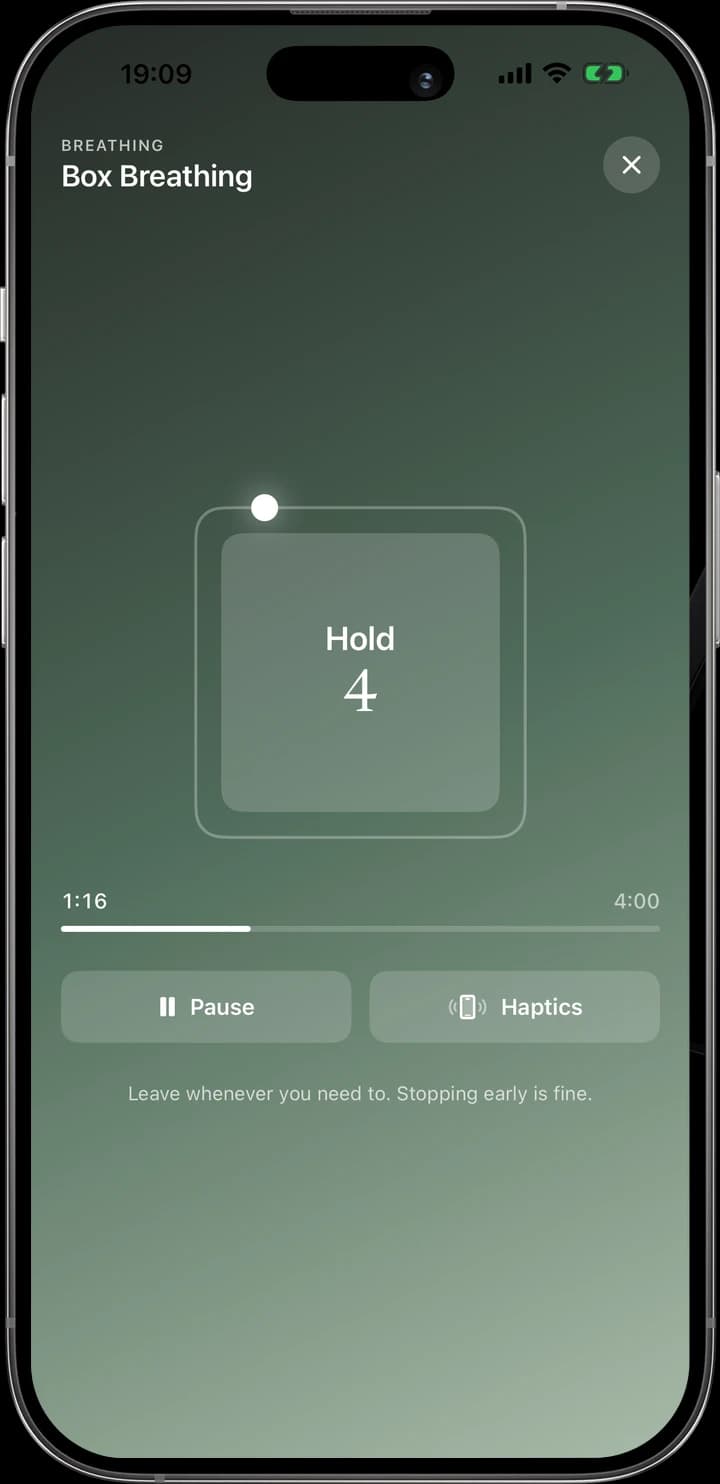
Guided practice: A box pacer with pause, haptics and exit. Before and after states are optional; ending early is fine.
Guided practiceA box pacer with pause, haptics and exit. Before and after states are optional; ending early is fine.
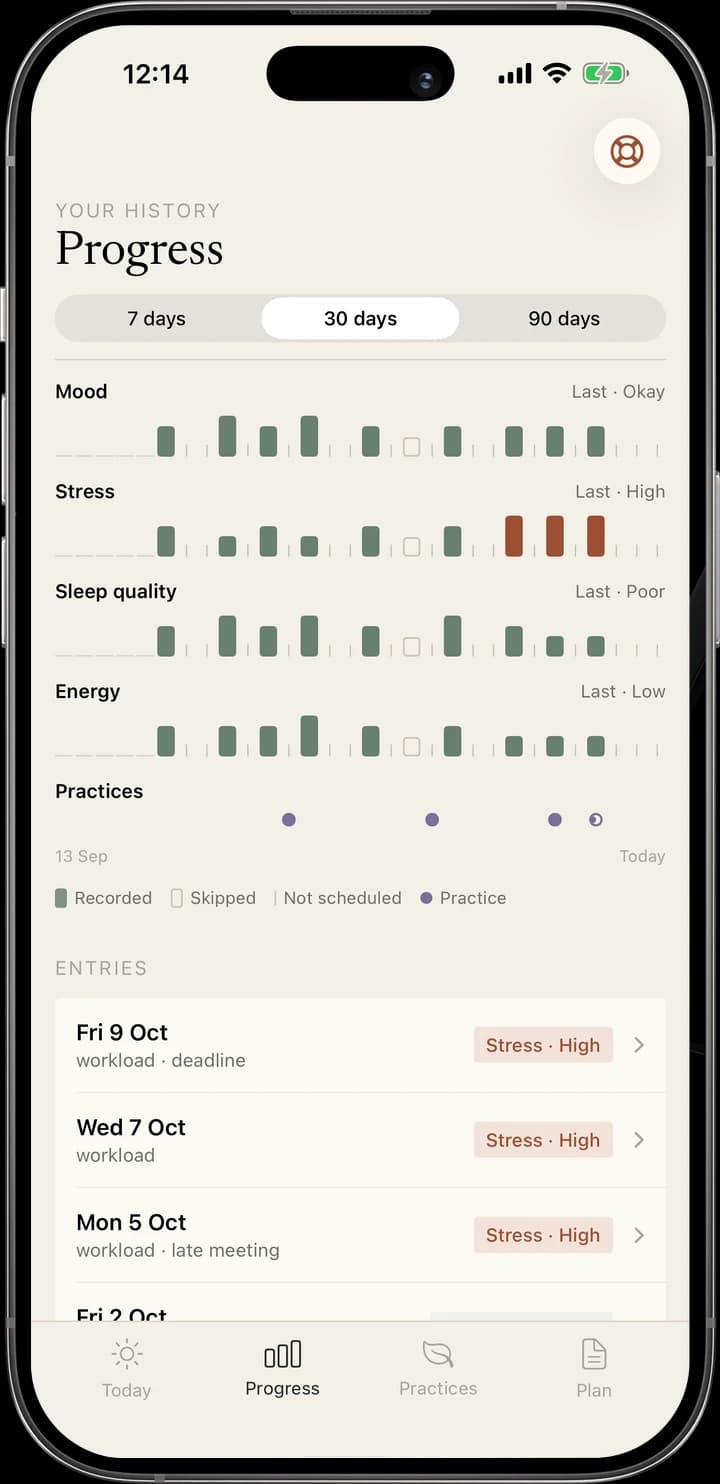
Progress: Separate lanes per metric over 7, 30 or 90 days. Skipped and unscheduled days look different; practices are events.
ProgressSeparate lanes per metric over 7, 30 or 90 days. Skipped and unscheduled days look different; practices are events.
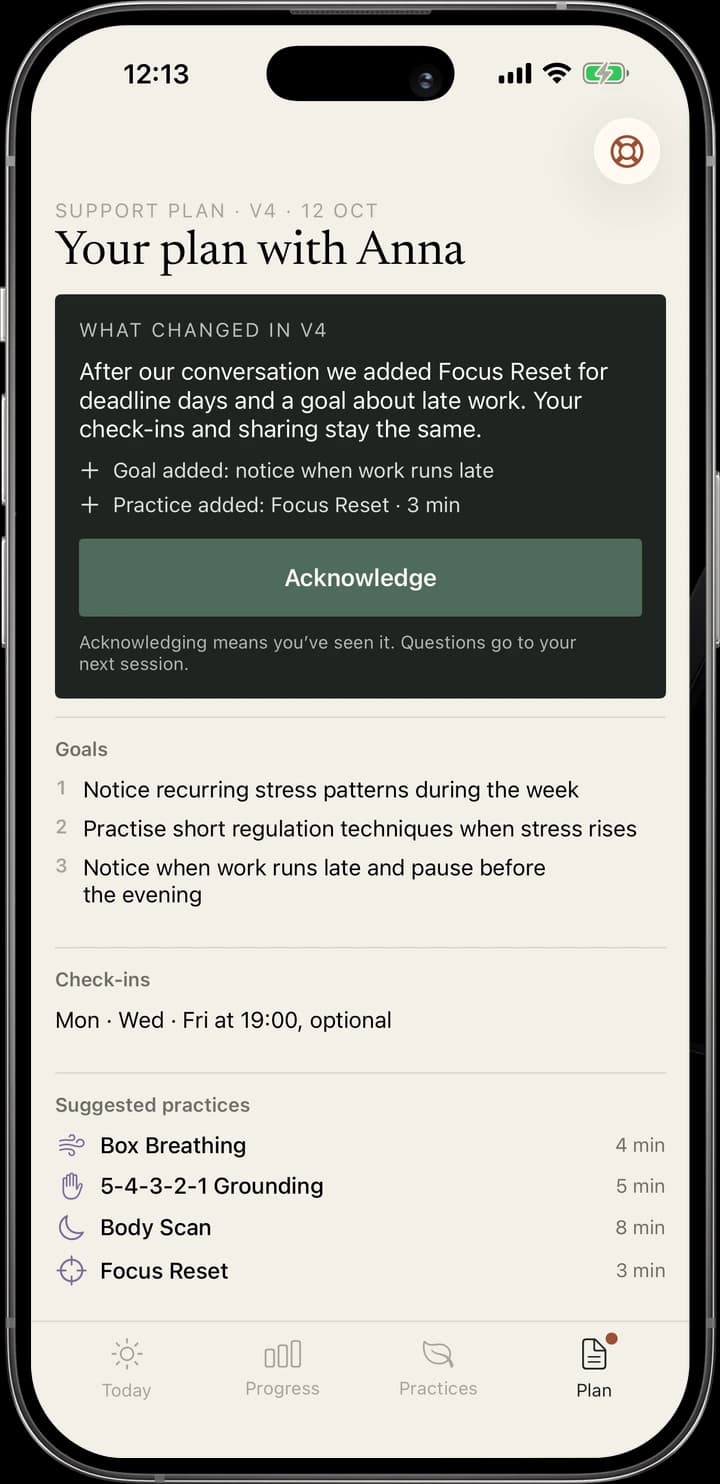
Support plan: What changed in the new version, goals, practices, who sees what and the sharing controls.
Support planWhat changed in the new version, goals, practices, who sees what and the sharing controls.
The same week, from Maya’s phone

The recordings replay the moments the dashboard shows from the other side: the Friday check-in that became Anna’s signal, plan v4 arriving after the session, and a client pausing what they share.

Scenario A · Friday 9 Oct, 19:00

A check-in that turns into a choice, not a task

A neutral reminder, four scales with words, two tags and a note are saved and synced in about half a minute. The reflection mirrors what was recorded and offers a few practices. Maya starts Box Breathing, gets interrupted at 1:40 and leaves without a mark against her. This is the entry and the practice Anna opens on Monday.

Scenario B · Monday 12 Oct, after the session

A new plan version arrives, explained

The lock screen says only that the plan changed. Inside, “What changed” lists the added goal and Focus Reset in the words Anna wrote. Acknowledging means “I’ve seen it”, not consent to anything new. Progress then shows the week the session was about, gaps and practices included.

Scenario C · Sharing on the client’s terms

Pausing sharing is one clear decision

Daniel pauses sharing from his plan. The confirmation states what happens: new entries stay on the phone, Anna keeps what was already shared, and the plan and sessions do not change. His next check-in is saved privately. The dashboard shows the same moment as “sharing paused” in chapter 04.

Chapter 04 · Psychologist · Web

Silence is context, and sharing stays the client’s choice

Daniel has skipped three check-ins. The dashboard shows only what it actually knows: reminders were delivered and the app still syncs. It leaves the reason for the gap open for the next session. When Daniel pauses sharing, the product explains what the psychologist can still see and closes the signal it can no longer evaluate.

Problem
A gap can mean fatigue, a technical problem or a choice. Read as deterioration, it leads to intrusive outreach; a revoked share read as a warning breaks trust.
Hypothesis
Showing only known facts such as reminders, sync and access keeps the psychologist informed without interpreting the client. Anything the system can no longer evaluate is closed.
What the domain says
Missing data is ambiguousA gap may mean low energy, notification fatigue, a technical problem or a choice not to log. It is context, not evidence of deterioration.
IntervalNorthbank PsychologyFind a clientMon 12 Oct09:10AWAnna WilsonPsychologist

Monday, 12 October · 3 open signals, 3 before today’s sessions

Active plans
12/14
Check-ins · 7 d
25/27
Reviews due
4
Next · review at 11:30

Daniel Okafor

No check-ins for 7 days — No entry for 7 days while at least one was scheduled, 2 – 9 Oct.

Also needs you 2

  • Maya ChenRepeated high stressReview when preparing session · owner you
  • Priya RamanSleep pattern changedReview when preparing session · owner you
ClientLast check-inLast 14 daysStatusPlanReviewed
MCMaya ChenSince 18 Sep3 days agoRepeated high stressNewv3Active2 Oct · session
SMSofia MarquezSince 3 AugToday, 08:41—v5Active8 Oct
PRPriya RamanSince 14 JulToday, 07:55Sleep pattern changedViewedv2Active6 Oct
DODaniel OkaforSince 21 Aug10 days agoNo check-ins for 7 daysNotedv2Active9 Oct · Leo M.
LFLucas FerreiraSince 1 Sep3 days agoSync delayed—v1Active5 Oct
JLJonas LindqvistSince 27 Jul10 days agoSharing paused—v3Active2 Oct
ANAmara NwosuSince 10 Jun4 days ago—v4Active1 Oct
TBTom BeckerSince 2 Jun10 days ago—v3Paused2 Oct
EPElena PopescuSince 5 Sep3 days ago—v2Active7 Oct
KWKenji WatanabeSince 19 Aug3 days ago—v3Active8 Oct
HWHannah WrightSince 30 Jun3 days ago—v2Active5 Oct
OBOlivia BrooksSince 12 AugYesterday, 10:30—v1Active9 Oct
NSNoah SchmidtSince 26 Aug3 days ago—v2Active6 Oct
ZAZara AhmedInvited 8 OctNo entries yet——Invited9 Oct · intake
Last 14 daysRecordedSkippedWaiting to syncPrivate
01Open Daniel’s gap signal
Free demo

Walk around the psychologist’s tool

The same interface without a script: open signals, switch filters, go through a client’s check-ins, session preparation and support plans. Time is simulated and moves only when you act.

IntervalNorthbank PsychologyFind a clientMon 12 Oct09:10AWAnna WilsonPsychologist

Monday, 12 October · 3 open signals, 3 before today’s sessions

Active plans
12/14
Check-ins · 7 d
25/27
Reviews due
4
Next · session at 10:00

Maya Chen

Repeated high stress — Stress 4–5 in 3 of the last 4 check-ins, 2 – 9 Oct.

Also needs you 2

  • Priya RamanSleep pattern changedReview when preparing session · owner you
  • Daniel OkaforNo check-ins for 7 daysReview soon · owner Leo
ClientLast check-inLast 14 daysStatusPlanReviewed
MCMaya ChenSince 18 Sep3 days agoRepeated high stressNewv3Active2 Oct · session
SMSofia MarquezSince 3 AugToday, 08:41—v5Active8 Oct
PRPriya RamanSince 14 JulToday, 07:55Sleep pattern changedViewedv2Active6 Oct
DODaniel OkaforSince 21 Aug10 days agoNo check-ins for 7 daysNotedv2Active9 Oct · Leo M.
LFLucas FerreiraSince 1 Sep3 days agoSync delayed—v1Active5 Oct
JLJonas LindqvistSince 27 Jul10 days agoSharing paused—v3Active2 Oct
ANAmara NwosuSince 10 Jun4 days ago—v4Active1 Oct
TBTom BeckerSince 2 Jun10 days ago—v3Paused2 Oct
EPElena PopescuSince 5 Sep3 days ago—v2Active7 Oct
KWKenji WatanabeSince 19 Aug3 days ago—v3Active8 Oct
HWHannah WrightSince 30 Jun3 days ago—v2Active5 Oct
OBOlivia BrooksSince 12 AugYesterday, 10:30—v1Active9 Oct
NSNoah SchmidtSince 26 Aug3 days ago—v2Active6 Oct
ZAZara AhmedInvited 8 OctNo entries yet——Invited9 Oct · intake
Last 14 daysRecordedSkippedWaiting to syncPrivate
Free demo · click around the psychologist’s tool

Responsible monitoring requires visible limits

The dashboard receives data near real time, but the service is not continuously monitored and is not designed for urgent help. This boundary must be clear before a client shares information.

Attention signal
Use neutral language such as “Repeated high stress” or “No check-ins for 7 days”; always link to source entries.
Response expectation
Show when entries are usually reviewed and state that an immediate response is not guaranteed.
Urgent support
Keep local emergency and crisis resources directly available; do not route them through the dashboard.
Practice result
Store an optional before/after self-report; never label a practice effective or imply causality.
Changed sharing
Stop future sharing, preserve required history and explain what the psychologist can still see.
Data minimisation
Do not collect information unless the service can explain its purpose, access and follow-up.
Behind the screens

One support relationship, three active roles

The main relationship is between the client and psychologist. A care coordinator can support continuity when a practice works as a team; administration remains a background capability.

01

Client

Records a state with low effort, chooses a practice, sees personal patterns and controls sharing.

02

Psychologist

Monitors a caseload, understands change, prepares for sessions and updates the support plan.

03

Care coordinator

Maintains ownership, follows up on operational gaps and supports continuity across a care team.

04

Administrator

Configures access, practice content, retention, integrations and audit history in the background.

Two products, one shared support record

The iOS app serves the client in the moment. The web dashboard gives a psychologist two modes: ongoing caseload monitoring and focused session preparation. Both use the same observations, practices, signals and support-plan versions.

Client · iOS

Support that starts with the present moment

A short check-in, agreed practices, optional before-and-after reflection, personal history and a clear support plan.

  • Today
  • Check-in
  • Practices
  • Progress
  • Support plan
Psychologist · Web

Patterns and context across a caseload

Recent activity, explainable attention signals, a client timeline, session preparation and support-plan editing.

  • Caseload
  • Attention signals
  • Client overview
  • Session preparation
  • Support plan
Shared support service

Identity · consent · observations · practices · signals · support plans · audit

Design system

Calm by default, clear about what is missing

One token set serves the psychologist’s tool and the client’s iOS app, so a check-in, a practice or a plan change reads the same on both sides. The palette comes from the app: warm paper, ink for text and actions, sage for client data and terracotta only for what changed. People and words are set in Newsreader, the interface in Instrument Sans; the web keeps square corners, the app keeps its soft round controls.

Missing data is designed as carefully as data. A skipped check-in, an expected one and a private entry each have their own texture, so silence is never drawn as a low value.

Warm paper and inkA warm, low-chroma neutral shared with the client app keeps the tool calm for a full day of client work.
  • paper.100#f3efe7App background
  • paper.0#fbf9f4Cards, panels, sheets
  • paper.50#f6f1e8Inset, row hover, next session
  • paper.200#ece7ddEmpty day, counters, quiet chips
  • ink.900#1f2421Text, primary action, focus card

Stone tiers

  • ink.900
  • stone.600
  • stone.400
  • stone.300
  • stone.200
  • stone.100

Secondary text and lines are fixed warm greys, not opacities, so they stay the same on paper and on sheets.

Semantic tokensScreens use roles, not hex values.

Background & surface

  • color.background.apppaper.100
  • color.surface.primarypaper.0
  • color.surface.insetpaper.50
  • color.surface.emptypaper.200

Text & action

  • color.text.primaryink.900
  • color.text.secondarystone.600
  • color.action.primaryink.900
  • color.border.defaultstone.100

Client data

  • color.data.entrysage.500
  • color.data.entry-inksage.700
  • color.data.entry-softsage.100
  • color.data.practiceplum.500

What changed

  • color.signal.inkterracotta.600
  • color.signal.softterracotta.100
  • color.state.donesage.500
Data and missing dataA gap is context, not a low value: each kind of missing data has its own texture. The same encoding is used on the web and in the app.

Entries

  • Check-in value#4f6b5a
  • High stress#9c4f34
  • Practice#7a6f9b
  • Today marker#1f2421

Missing data

  • Skipped · outline
  • Expected · dashed
  • Private · hatched

Signal states

  • New
  • Noted
  • Closed

Measure whether the loop becomes useful

The primary outcome is the share of active support relationships with enough timely, understandable context for a planned discussion and an agreed follow-up. Daily opens and the amount of data collected are not the goal.

Guardrails include check-in time, reminder opt-outs, low-value or unreviewed signals, failed sync, revoked sharing and psychologist preparation time.

  1. 01Plan activated
  2. 02Check-in recorded
  3. 03Practice completed
  4. 04Signal reviewed
  5. 05Discussed in session
  6. 06Plan adjusted

Validation approach

01

Workflow interviews

Psychologists, clients and care coordinators reconstruct one real week between consultations.

02

Boundary comprehension

Verify that clients understand sharing, review cadence, signals and the absence of emergency monitoring.

03

Scenario simulation

Run missed check-ins, repeated stress, failed sync, changed sharing and a psychologist away from work.

04

Practice usability

Test whether a client can choose, start, pause and leave a practice without pressure or implied medical benefit.

Principles behind the decisions

Each row starts with a principle from research or professional guidance and ends where it shows up in the product. Numbers lead to the sources below; the exact workflow still depends on the rules of the target country and organisation.

PrincipleWhat it meansDecisionWhere to see it
01Measures help when they are discussed1

Measurement-based care works when routine self-reports are reviewed with the client and feed decisions about care, not when they are only collected.

Check-ins flow into session preparation and the next plan version. Success is “discussed in session → plan adjusted”, not daily opens.

02Track the caseload, follow up on change2

A simple registry of who is in care makes it possible to notice people who change or drop off before the next appointment.

The caseload is ordered by recent activity and explainable attention signals: reason, source entries, age and owner, without a risk score or emergency SLA.

03Self-report in plain words3

Validated self-report items use short recall periods and verbal answer options that people read the same way.

Four scales labelled with words instead of numbers, every field can be skipped, about 45 seconds. Progress shows a lane per metric, not a total score.

04Collect only what has a purpose4

Health-app privacy guidance asks for the minimum necessary data and clarity about who can access it.

Support starts with a plan before any data. The client chooses what to share and sees the sharing scope before saving each entry.

05Consent can change5

Behavioural-health data needs consent the person can narrow or withdraw, with clear rules for what was already shared.

Pausing sharing stops new entries, keeps what was shared, closes signals the system can no longer evaluate and explains this to both sides.

06Urgent help is local and direct6

Crisis support depends on the country; a between-session service is not an emergency channel.

Local crisis lines are one tap away in the app and never routed through the dashboard. The review window is stated; an immediate response is not promised.

What the product brings together

The product supports the time between consultations without turning it into treatment or constant surveillance. It connects client check-ins, self-regulation practices, explainable attention signals and a shared support plan around the conversation with a psychologist.

The web dashboard and iOS app tell the same story from two sides. The psychologist sees context across a caseload and prepares for a session; the client records a state, chooses a practice, follows personal progress and controls what is shared.